

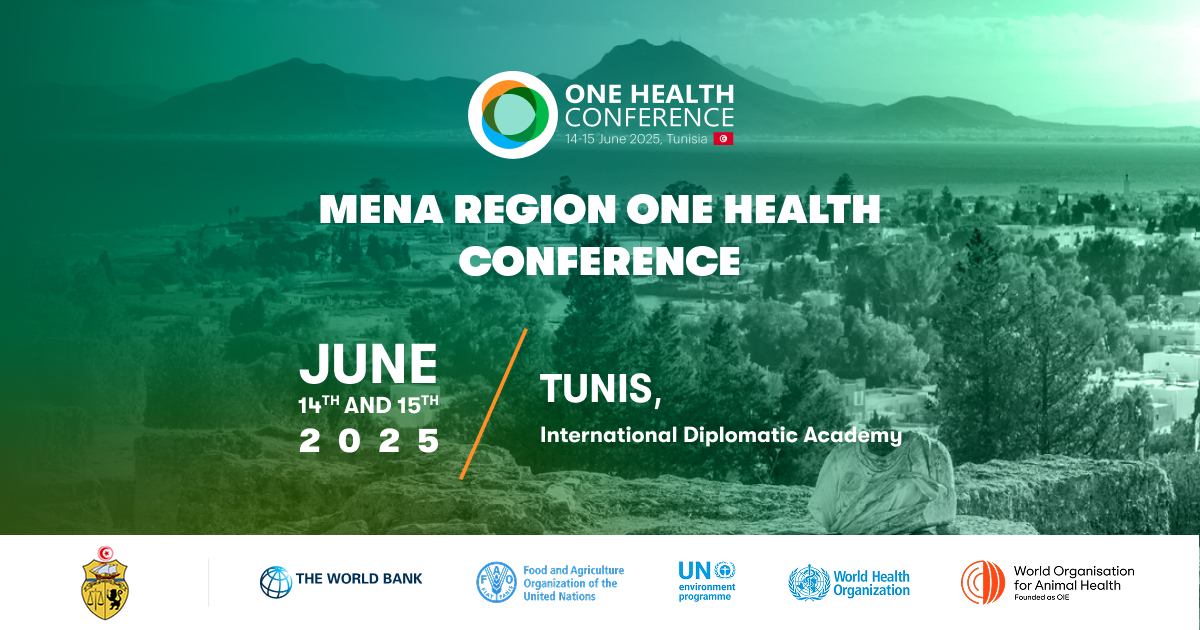
Tunisia will host the first MENA Regional “One Health” Conference on June 14–15, 2025, marking a landmark step in advancing coordinated action across health, agriculture, and environmental sectors to address zoonotic diseases and pandemic risks.
The event, which will bring together delegates from 17 countries across the Middle East and North Africa, will convene over 40 high-level officials, including 10 ministers and senior representatives from national ministries, United Nations agencies, and global development institutions.
The conference is funded by the World Bank and supported by key international bodies, including the World Health Organization (WHO), Food and Agriculture Organization (FAO), UN Environment Programme (UNEP), and the World Organisation for Animal Health (WOAH).
Announcing the event during a press briefing at the Pasteur Institute of Tunis, Prof. Hechmi Louzir, Chair of the Scientific Committee, underscored the conference’s significance in promoting regional solidarity and cross-sectoral frameworks for pandemic prevention and ecosystem health.
“The ‘One Health’ approach has become indispensable, particularly as more than 70% of emerging human diseases originate from animals,” Louzir said.
Carthage Declaration for One Health
A central feature of the gathering will be the introduction of the “Carthage Declaration for One Health”, a policy pact proposed by Tunisia to foster joint governance between health, agriculture, and environmental authorities. The declaration has already been circulated to participating nations and is expected to be adopted during the summit.
The document outlines core principles for integrated health security, data sharing, and coordinated crisis response mechanisms—setting the foundation for future implementation across the region.
Strengthening Institutional Architecture
Dr. Abderrazek Bouzouita, Director-General of Health at Tunisia’s Ministry of Health, noted that the conference is strategically timed to address climate-linked disease vulnerabilities and bolster public health systems in the face of global disruptions.
“This platform will unify national and regional policies, facilitate knowledge exchange, and drive institutional commitments to the One Health paradigm,” he added.
Wahib Mehri, Director-General of Veterinary Services at the Ministry of Agriculture, Fisheries and Water Resources, emphasized the need for a permanent coordination mechanism between sectors, including real-time data integration to enhance disease surveillance and outbreak prevention.
Meanwhile, Mosbah Abaza, Director-General of Sustainable Development at the Ministry of Environment, drew attention to the interdependence of environmental, agricultural, and health systems, stressing that any imbalance can trigger cascading effects across sectors.
“From wastewater treatment to coastal preservation, the environment ministry plays a critical role in the One Health ecosystem,” Abaza said.
Toward a Unified Regional Health Agenda
The upcoming conference is expected to generate tangible recommendations and foster deeper partnerships to institutionalize the One Health approach across MENA. It represents a proactive move by Tunisia to champion science-based policymaking, holistic disease control, and resilience-building in a region increasingly exposed to ecological and epidemiological threats.

